
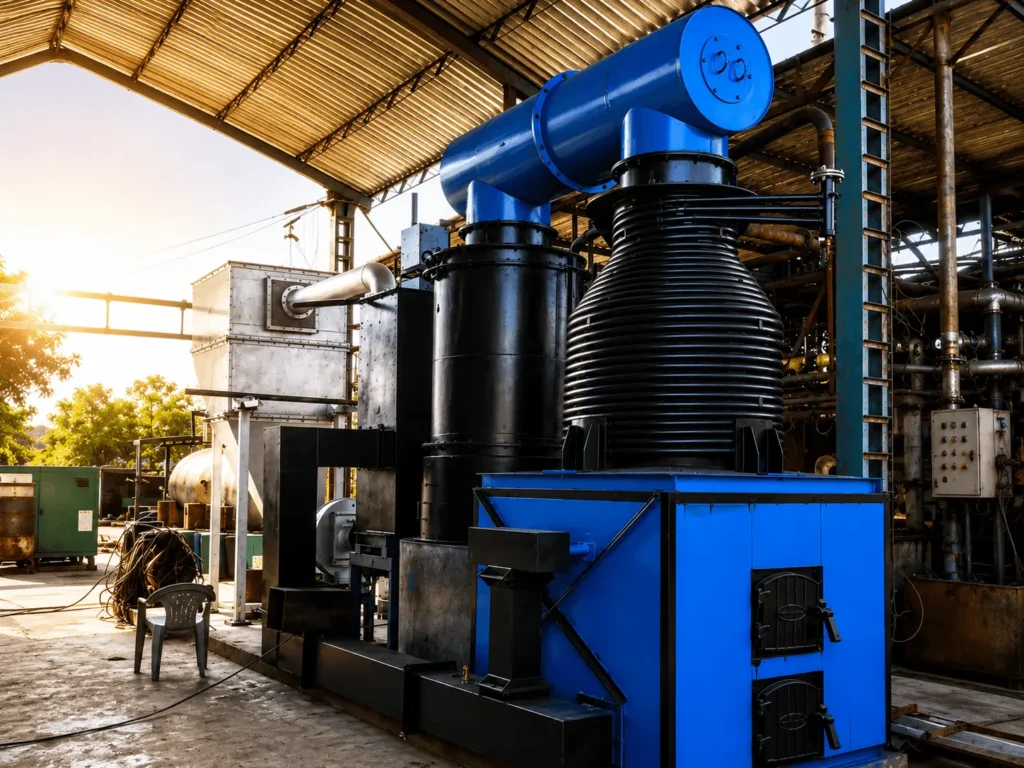
Everything You Need to Know About Thermic Fluid Heating Systems
In modern industries, maintaining a consistent and efficient heat supply is critical for production quality and energy efficiency. While steam boilers are widely used for many applications, thermic fluid heaters have become the preferred solution where high temperatures at low operating pressure are required.
This guide explains what a thermic fluid heater is, how it works, its advantages, applications, types, maintenance, and how to choose the right system for your process.
What is a Thermic Fluid Heater?
A Thermic Fluid Heater (TFH) is an indirect heating system that transfers heat to industrial processes by circulating a specially formulated heat transfer fluid (thermal oil) instead of water or steam.
Unlike steam boilers, thermic fluid heaters can achieve temperatures of up to 300–350°C while operating at low pressure, making them safer and more energy-efficient for many industrial heating applications.
How Does a Thermic Fluid Heater Work?
The system operates in a closed-loop circuit:
- A burner or solid fuel furnace generates heat.
- The heat is transferred to the thermic fluid flowing through the heater coil.
- A circulation pump continuously moves the hot fluid to process equipment.
- The fluid transfers heat through heat exchangers, reactors, dryers, or other process equipment.
- The cooled fluid returns to the heater for reheating.
This continuous cycle ensures stable and uniform process heating.
Main Components of a Thermic Fluid Heater
- Heater Coil
- Combustion Chamber
- Burner or Solid Fuel Furnace
- Thermic Fluid Circulation Pump
- Expansion Tank
- Deaeration Tank
- Chimney
- ID Fan & FD Fan (Solid Fuel Models)
- Control Panel (PLC/HMI)
- Temperature Sensors
- Pressure Gauges
- Safety Valves
- Isolation Valves
- Piping & Insulation
Types of Thermic Fluid Heaters
Oil & Gas Fired Thermic Fluid Heater
Suitable Fuels
- Natural Gas
- LPG
- Diesel
- Furnace Oil
- LDO
Advantages
- High thermal efficiency
- Automatic operation
- Clean combustion
- Low maintenance
Solid Fuel Fired Thermic Fluid Heater
Suitable Fuels
- Coal
- Biomass Briquettes
- Rice Husk
- Sawdust
- Wood Chips
- Wood Pellets
- Bagasse
- Agro Waste
Advantages
- Lower operating cost
- Renewable fuel options
- Suitable for continuous industrial operation
Electric Thermic Fluid Heater
Advantages
- Zero combustion emissions at the point of use
- Compact installation
- Precise temperature control
- Quiet operation
Advantages of Thermic Fluid Heaters
- High operating temperatures at low pressure
- Uniform and stable heat transfer
- Excellent temperature control
- Lower maintenance than many steam systems
- No condensate return system required
- No boiler feedwater treatment required
- Reduced corrosion and scaling issues
- High thermal efficiency
- Suitable for continuous industrial processes
- Long service life with proper maintenance
Steam Boiler vs Thermic Fluid Heater
| Parameter | Steam Boiler | Thermic Fluid Heater |
|---|---|---|
| Heating Medium | Steam | Thermic Fluid |
| Operating Pressure | High | Low |
| Maximum Temperature | Limited by pressure | Up to 350°C (depending on fluid) |
| Water Treatment | Required | Not Required |
| Condensate Recovery | Required | Not Applicable |
| Scaling Risk | Yes | No |
| Corrosion Risk | Higher | Lower |
| Process Temperature Stability | Good | Excellent |
Industrial Applications
Thermic fluid heaters are widely used in:
- Chemical Industries
- Pharmaceutical Plants
- Textile Processing
- Food Processing
- Edible Oil Refineries
- Asphalt & Bitumen Plants
- Paint & Resin Manufacturing
- Plywood & Laminate Industries
- Rubber & Tyre Manufacturing
- Plastic Processing
- Packaging Industries
- Paper & Pulp Mills
- Printing & Coating Plants
- Wood Processing
- Solar Thermal Systems
How to Select the Right Thermic Fluid Heater
Consider the following factors:
- Required heat load (kcal/hr or kW)
- Process operating temperature
- Fuel availability
- Fuel cost
- Thermal efficiency
- Process type
- Installation space
- Emission requirements
- Automation level
- Future capacity expansion
Fuel Options
Common fuels include:
- Natural Gas
- LPG
- Diesel
- Furnace Oil
- Coal
- Biomass Briquettes
- Rice Husk
- Wood Pellets
- Sawdust
- Bagasse
- Agro Waste
Choose the fuel based on availability, operating cost, and environmental compliance.
Maintenance Best Practices
- Monitor thermic fluid temperature.
- Check circulation pump performance.
- Inspect burner and combustion system.
- Clean heating surfaces regularly.
- Inspect insulation.
- Check expansion tank level.
- Monitor thermic fluid condition.
- Replace degraded thermic fluid when recommended.
- Inspect piping for leaks.
- Maintain proper combustion settings.
Common Problems and Solutions
| Problem | Possible Cause | Solution |
|---|---|---|
| Low Outlet Temperature | Dirty coil, poor combustion | Clean coil and tune burner |
| High Fuel Consumption | Scale/soot, excess air | Improve combustion and maintenance |
| Pump Noise | Air in system | Vent the system and inspect pump |
| Fluid Degradation | Overheating | Maintain correct operating temperature |
| Uneven Heating | Poor circulation | Inspect pump and piping |
| Smoke Emissions | Improper combustion | Adjust air-fuel ratio |
Safety Precautions
- Never exceed the maximum allowable fluid temperature.
- Maintain adequate fluid circulation before firing.
- Check expansion tank level regularly.
- Monitor pressure and temperature continuously.
- Inspect all safety devices periodically.
- Use only recommended heat transfer fluids.
- Ensure proper ventilation in the boiler house.
- Follow lockout/tagout procedures during maintenance.
Benefits of Choosing a Thermic Fluid Heater
- Lower operating pressure enhances safety.
- Excellent temperature uniformity for sensitive processes.
- Lower maintenance due to the absence of scaling and condensate systems.
- High thermal efficiency reduces energy costs.
- Wide range of fuel options.
- Reliable operation for continuous industrial production.
Conclusion
Thermic fluid heaters are an excellent choice for industries requiring high-temperature process heating with low operating pressure. They provide efficient heat transfer, consistent temperature control, lower maintenance, and flexible fuel options, making them suitable for a wide range of industrial applications.
Selecting the right heater, maintaining the thermic fluid properly, and following preventive maintenance practices will ensure long-term, energy-efficient, and reliable operation.
Why Choose Steamtherm Boilers Pvt. Ltd.?
Steamtherm Boilers Pvt. Ltd. manufactures advanced oil & gas fired, solid fuel fired, and custom-engineered thermic fluid heaters designed for modern industries. Our solutions combine high thermal efficiency, reliable performance, robust construction, and comprehensive engineering support—from design and manufacturing to installation, commissioning, and after-sales service.
Need help selecting the right thermic fluid heater? Contact Steamtherm Boilers for expert engineering guidance and a customized solution tailored to your process heating requirements.