
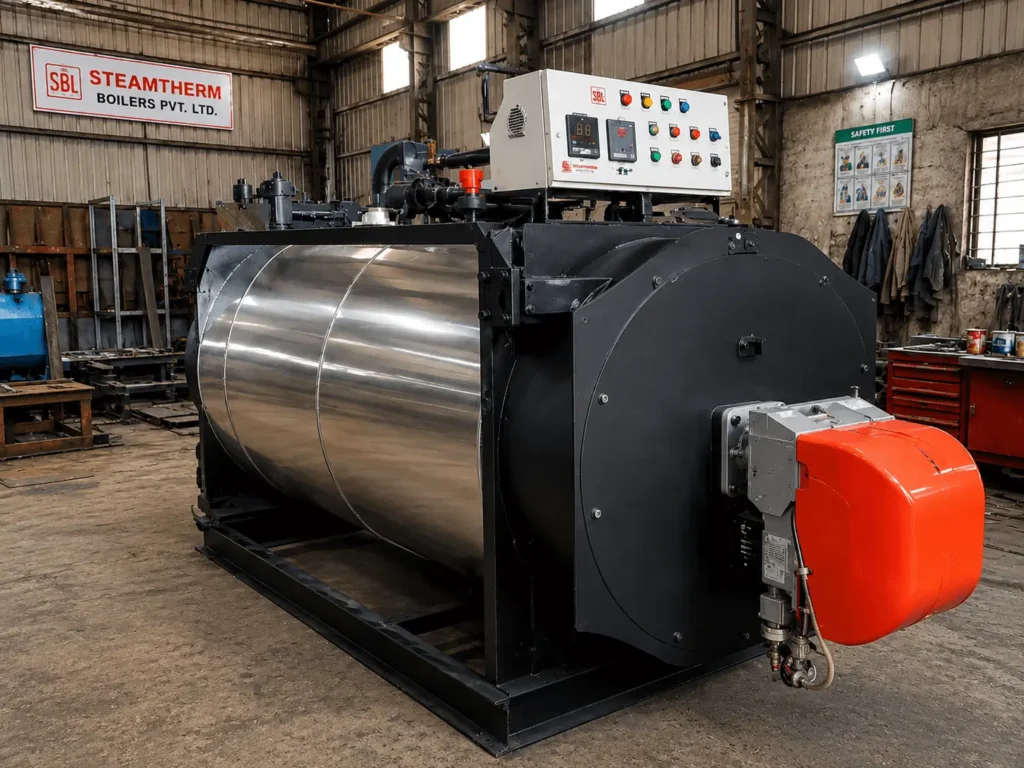
Everything You Need to Know About Industrial Hot Water Generators
Hot water is widely used across industries for process heating, cleaning, washing, HVAC systems, and temperature-controlled manufacturing. Compared to steam systems, Hot Water Generators (HWGs) provide a safe, efficient, and cost-effective solution for applications that require hot water instead of steam.
This guide explains what a Hot Water Generator is, how it works, its advantages, applications, fuel options, maintenance, and how to select the right system for your facility.
What is a Hot Water Generator?
A Hot Water Generator (HWG) is a heating system designed to produce hot water by transferring heat from fuel combustion or electric heating elements to circulating water. Unlike a steam boiler, the water remains in its liquid state and is supplied to the process at a controlled temperature.
Hot water generators are commonly used where temperatures between 60°C and 140°C are required for continuous industrial and commercial operations.
How Does a Hot Water Generator Work?
The working principle involves a closed-loop circulation system:
- Water is stored in a buffer or expansion tank.
- A burner or electric heating element generates heat.
- Heat is transferred to the water through a heat exchanger or water tubes.
- A circulation pump delivers hot water to the process.
- After transferring heat, the cooled water returns to the generator for reheating.
- Temperature is automatically controlled using sensors and controllers.
Main Components of a Hot Water Generator
- Hot Water Generator Body
- Furnace / Combustion Chamber
- Heat Exchanger
- Burner or Solid Fuel Furnace
- Circulation Pump
- Expansion Tank
- Temperature Controller
- Pressure Gauge
- Thermometer
- Safety Valve
- Air Vent
- Chimney
- Control Panel (PLC/HMI Optional)
- Insulated Piping
Types of Hot Water Generators
Oil & Gas Fired Hot Water Generator
Suitable Fuels
- Natural Gas
- LPG
- Diesel
- Furnace Oil (FO)
- Light Diesel Oil (LDO)
Advantages
- High thermal efficiency
- Automatic operation
- Clean combustion
- Low maintenance
- Fast heat-up time
Solid Fuel Fired Hot Water Generator
Suitable Fuels
- Coal
- Biomass Briquettes
- Rice Husk
- Wood Pellets
- Sawdust
- Bagasse
- Agro Waste
Advantages
- Low operating cost
- Renewable fuel options
- Suitable for continuous industrial heating
Electric Hot Water Generator
Advantages
- Zero on-site combustion emissions
- Compact installation
- Precise temperature control
- Quiet operation
- Minimal maintenance
Advantages of Hot Water Generators
- High thermal efficiency
- Safe low-pressure operation
- Uniform water temperature
- Lower operating costs
- Easy installation
- Compact footprint
- Low maintenance
- Long service life
- Flexible fuel options
- Reliable continuous operation
Hot Water Generator vs Steam Boiler
| Parameter | Hot Water Generator | Steam Boiler |
|---|---|---|
| Heating Medium | Hot Water | Steam |
| Operating Pressure | Low | High |
| Water Temperature | Up to 140°C (higher in pressurized systems) | Steam at various pressures |
| Water Treatment | Basic treatment recommended | Essential |
| Condensate System | Not Required | Required |
| Applications | Heating, Washing, HVAC | Process Steam, Sterilization |
| Maintenance | Lower | Moderate |
Industrial Applications
Hot Water Generators are widely used in:
- Food Processing Plants
- Dairy Industry
- Pharmaceutical Manufacturing
- Hotels & Resorts
- Hospitals
- Textile Industry
- Chemical Plants
- Breweries & Distilleries
- Commercial Laundry
- HVAC Heating Systems
- Greenhouses
- Paper Industry
- Automobile Industry
- Construction Industry
- Residential & Commercial Buildings
Common Process Applications
Hot water generators are suitable for:
- Process heating
- CIP (Clean-in-Place) systems
- Washing and cleaning
- Bottle washing
- Tank heating
- Jacketed vessel heating
- Space heating
- Domestic hot water supply
- Heat exchangers
- HVAC systems
Temperature Range
Typical operating temperatures:
| Application | Temperature |
|---|---|
| Domestic Hot Water | 60–80°C |
| Industrial Washing | 70–90°C |
| Process Heating | 90–120°C |
| Pressurized Systems | Up to 140°C (or higher depending on design) |
Fuel Options
Industrial hot water generators can operate on:
- Natural Gas
- LPG
- Diesel
- Furnace Oil
- Coal
- Biomass Briquettes
- Rice Husk
- Wood Pellets
- Sawdust
- Agro Waste
- Electricity
Select the fuel based on availability, operating cost, environmental regulations, and process requirements.
How to Select the Right Hot Water Generator
Before selecting a system, evaluate:
- Required heating capacity (kW or kcal/hr)
- Water flow rate (LPH or m³/hr)
- Required outlet temperature
- Fuel type and availability
- Thermal efficiency
- Installation space
- Water quality
- Automation requirements
- Future expansion plans
- Environmental compliance
Maintenance Best Practices
- Check burner performance regularly.
- Inspect circulation pumps.
- Clean heat exchanger surfaces.
- Monitor water temperature and pressure.
- Check expansion tank level.
- Inspect insulation for heat loss.
- Maintain proper water quality.
- Calibrate temperature sensors.
- Perform periodic safety valve testing.
- Follow a preventive maintenance schedule.
Common Problems and Solutions
| Problem | Possible Cause | Solution |
|---|---|---|
| Low Water Temperature | Dirty heat exchanger | Clean heat transfer surfaces |
| High Fuel Consumption | Poor combustion | Tune burner and optimize air-fuel ratio |
| Pump Noise | Air in system | Vent air and inspect pump |
| Uneven Heating | Poor circulation | Check pump and piping |
| Temperature Fluctuation | Faulty controller | Calibrate or replace controller |
| Water Leakage | Damaged gasket or valve | Inspect and repair components |
Safety Precautions
- Never operate without adequate water circulation.
- Maintain proper expansion tank level.
- Test safety valves periodically.
- Monitor operating temperature and pressure.
- Inspect fuel lines for leaks.
- Ensure adequate ventilation in the boiler room.
- Use only trained personnel for operation and maintenance.
- Follow lockout/tagout (LOTO) procedures during servicing.
Benefits of Choosing a Hot Water Generator
- Lower operating costs compared to many heating alternatives.
- Improved process temperature control.
- Safe and reliable operation.
- Lower maintenance requirements.
- Energy-efficient heating.
- Flexible fuel choices.
- Compact installation.
- Long service life with proper maintenance.
Frequently Asked Questions (FAQs)
What is the difference between a Hot Water Generator and a Steam Boiler?
A Hot Water Generator supplies heated water, whereas a Steam Boiler converts water into steam for process applications.
What is the maximum temperature of a Hot Water Generator?
Most industrial systems operate up to 140°C, while specially designed pressurized systems can operate at higher temperatures.
Does a Hot Water Generator require water treatment?
Basic water treatment is recommended to reduce scaling and corrosion, although the requirements are generally less demanding than those for steam boilers.
Which industries use Hot Water Generators?
Food processing, pharmaceuticals, dairies, hotels, hospitals, textiles, chemicals, HVAC systems, and commercial laundries are among the major users.
Conclusion
Hot Water Generators provide an efficient, safe, and economical solution for industrial and commercial heating applications where steam is not required. Their low-pressure operation, precise temperature control, and flexible fuel options make them ideal for a wide range of process heating and utility applications.
Selecting the right capacity, fuel, and control system ensures reliable performance, lower energy consumption, and long-term operational savings.
Why Choose Steamtherm Boilers Pvt. Ltd.?
Steamtherm Boilers Pvt. Ltd. designs and manufactures high-efficiency Oil & Gas Fired, Solid Fuel Fired, and Electric Hot Water Generators for industrial and commercial applications. Our systems are engineered for maximum thermal performance, reliable operation, and low lifecycle costs, supported by complete engineering, installation, commissioning, and after-sales service.
Looking for the right Hot Water Generator for your application? Contact Steamtherm Boilers for expert engineering guidance and a customized heating solution tailored to your process requirements.